
The writing system of the kudamaf — pazan — is not a drawn alphabet but a continuous track. Whoever looks at it for the first time does not see a row of separate letters: they see an unbroken horizontal line, with vertical strokes, steps, and dots rising and falling on both sides. The impression is that of a technical drawing or a machine profile, and the impression is correct: the pazan was born on the drafting table of the Rasha workshops, where measurements were noted along the same three-line band used to trace profiles.
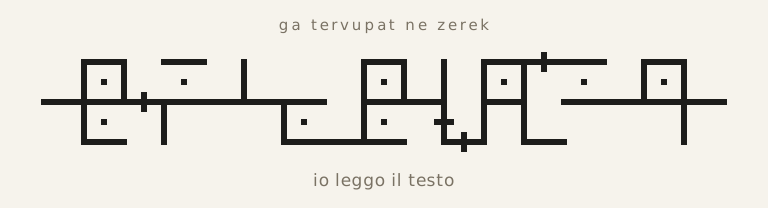
A whole sentence: four words in seventeen cells, without ever lifting the pen.
The Ribbon
Each letter occupies a cell of fixed width, crossed at its midpoint by a continuous horizontal line. Above and below that line, the letter arranges its own strokes: vertical stems to the left or right, high or low segments, a dot. The cells follow one another without interruption, and words do not separate: between one word and the next there is no space, only a thin dash resting on the first horizontal of the initial letter. The text is a single ribbon, from the beginning to the end of the line.
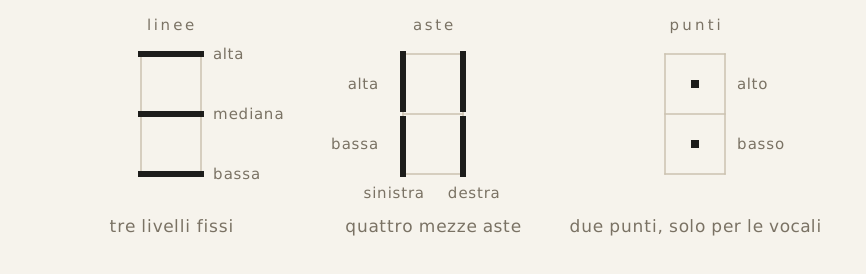
Everything a cell has on offer: three horizontal lines, four half-stems along the edges, two positions for the dot. Every letter is a choice within this inventory.
There are no capital letters or diacritical marks, and nothing is written that is not pronounced. Pauses, the comma of subordinate clauses, and digits are no exception to the ribbon: they occupy cells just like letters, and are described in Punctuation and Digits.
The Eighteen Letters
Vowels are recognized by the dot, which consonants never carry: a bears it twice, e only above, u only below. Consonants are distinguished by which lines they occupy and on which side their stems descend. The light box around each sign is the cell, and it is not actually drawn: here it only serves to show where the stroke falls.
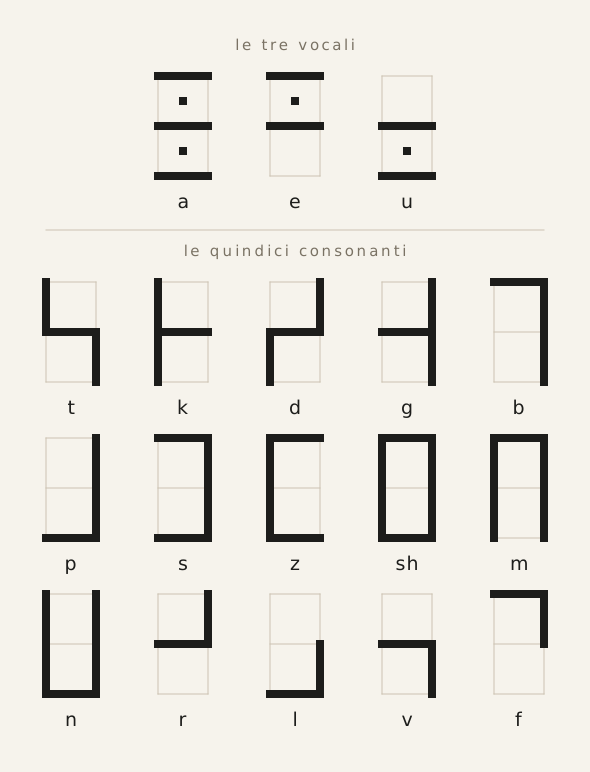
The three vowels and the fifteen consonants. The digraph sh counts as a single consonant and occupies a single cell.
The Shared Stem
The choice of a continuous ribbon comes at a price, and it is the central problem of calligraphy. At the boundary between two cells, the vertical stem is shared: whether it is drawn by the letter on the left or the one on the right, the same mark results.
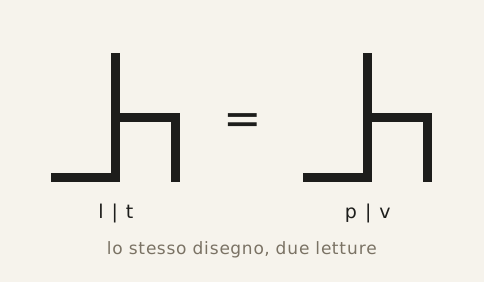
The drawing alone does not say where one letter ends and the other begins.
In the vast majority of cases this does not matter, because only one of the two readings is admitted by the phonotactics. But seven configurations turned out to be identical in pairs, and four of these pairs were composed of two equally valid readings.
The reform did not touch the alphabet — redrawing the letters would have cost nearly all fifteen consonants — but the language: within words, the less-used member of each pair was forbidden, and the register’s words that contained it were reformed.
The Separating Dash
The prohibition resolves the ambiguity within words, but not between different words, which in the continuous ribbon touch exactly as two letters would. Here a dedicated sign comes into play: an oblique dash, the same thickness as the word-separating dash and a little more than half a cell long, placed at the point where the letter that attaches breaks away from the stem.
The choice of point is not conventional but automatic: it is always the single junction where three or four lines converge. The other reading of the same pair has the letter attached at two points, and so it remains bare. The reader does not have to remember a rule: they only have to see whether the dash is there.
The seven configurations that require it are the following, each alongside the competing reading that the dash serves to exclude:
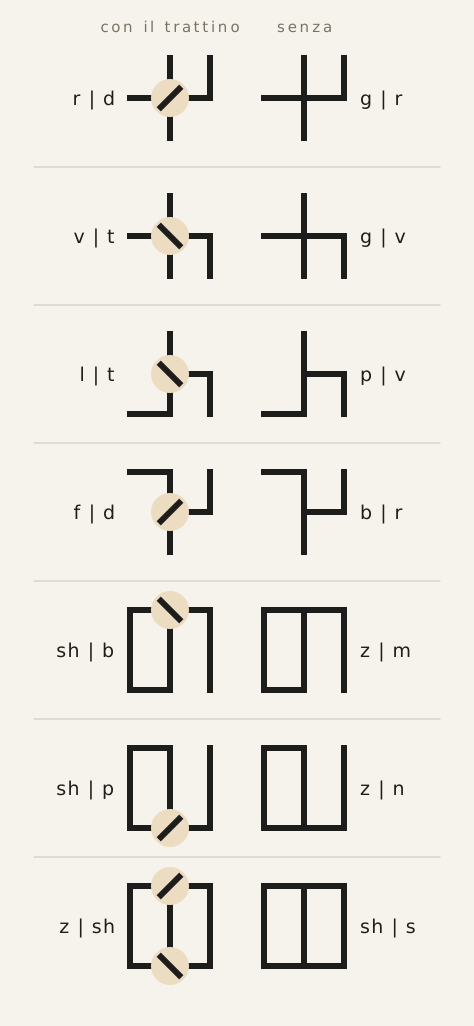
On the left, the valid reading, with the dash highlighted; on the right, the same drawing without it, that is, the other reading.
| pair | dash |
|---|---|
| r | d | ascending oblique, at midpoint |
| v | t | descending oblique, at midpoint |
| l | t | descending oblique, at midpoint |
| f | d | ascending oblique, at midpoint |
| sh | b | descending oblique, at top |
| sh | p | ascending oblique, at bottom |
| z | sh | ascending at top and descending at bottom |
The last is the only one that carries two dashes. In the recorded lexicon, this case occurs in fewer than 0.4% of contacts between letters: it is a rare sign, and it serves precisely because it is rare.