
The phonotactics of kudamaf is the strictest part of the language: it establishes which sounds exist, in what order they may stand, and which combinations are forbidden. In Earth languages impossible combinations are the residue of a history; here the prohibitions are deliberate, declared by the vepum of the Forum of Technical Arts, and almost all of them have a graphic reason: two sounds cannot meet if their written form would be ambiguous. The language, in other words, is bent to its own writing system.
Inventory
There are only three vowels:
a e u
There are no i and o: no word in the register contains them. There are fifteen consonants:
t k d g b p s z sh m n r l v f
The digraph sh stands for a single consonant and must be treated as one sign, both in syllable counting and in writing, where it occupies a single cell.
Syllables
Four syllable shapes are allowed: CV, CVC, VC, VCV. Every root is disyllabic and ends in a consonant: this is a necessary condition, because the three derivational suffixes all begin with a vowel (see Grammar) and two vowels can never touch. The ban on vowel contact is absolute: a-a, a-e, a-u, e-e, e-u, u-u never occur, either within a word or at the boundary between two words.
Consonant meetings
Twenty-three consonant pairs are forbidden. The table is read by rows: the row gives the first letter, the column the second.
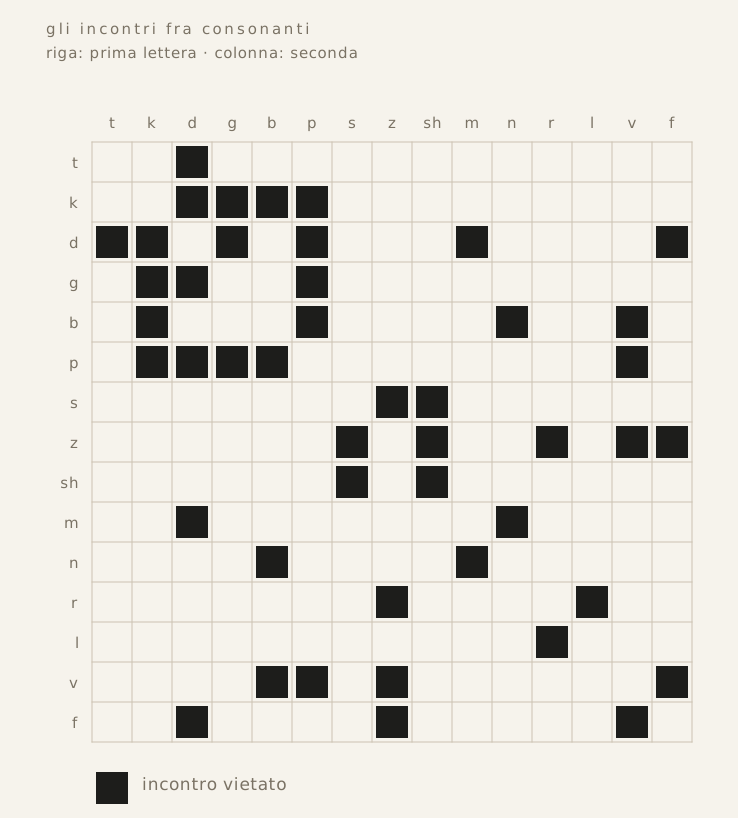
The filled cells are the meetings the rule does not allow. The table is symmetrical, with a single exception.
| dentals and velars | t-d, d-k, d-g, d-p, d-m, d-f, k-g, k-b, k-p, g-p |
| labials | b-p, b-n, b-v, p-v |
| sibilants | s-z, s-sh, z-r, z-v, z-f, sh-sh |
| nasals and liquids | m-n, r-l |
| fricatives | v-f |
The only asymmetry in the table is the directional prohibition of z before sh: in the reverse order, sh followed by z, the pair remains permitted. It is the exception that reveals the criterion, because it shows that what is forbidden is not the meeting of two sounds but a shape already occupied by another reading.
Why these specifically
The prohibitions do not arise from a notion of euphony but from a calculation. Having traced all possible pairs and triplets, seven configurations turned out to be graphically identical in pairs: the vertical stroke at the boundary between two cells belongs to both letters, and nothing indicated which of the two it was. Three of those seven were already impossible for other reasons; the other four were forbidden, and the register entries that contained them were remade. Since then no sequence permitted by the language can be read in two ways.
Only one case remains that the prohibition could not resolve, because it concerns the meeting between different words: it is resolved by the separating dash, described in Calligraphy.
Rigor
The rules on this page are not descriptive but binding: they apply to every entry admitted to the register. The 11,845 registered entries contain no violations of the table, and there is not a single pair of homographs among them.